Agentic AI: The Next Leap in Automation
Agentic AI refers to systems that can autonomously plan, execute, and adapt complex tasks with minimal human intervention. The shift from script-based automation to agentic orchestration is already underway across financial services, telecommunications, and healthcare engineering teams.
Why Agentic AI Matters Now
- Thousands of micro-decisions: Multi-agent systems can consume telemetry, align with policy, and actuate playbooks in seconds—far faster than weekly operations reviews.
- Resilience under change: Agents keep operating when market conditions, regulations, or upstream APIs shift; they replan using guardrails rather than waiting for humans to rewrite scripts.
- Embedded compliance: Static RPA often bypasses risk teams. Agentic workflows embed policy checks into every iteration, reducing audit surprises.
Reference Architecture Blueprint
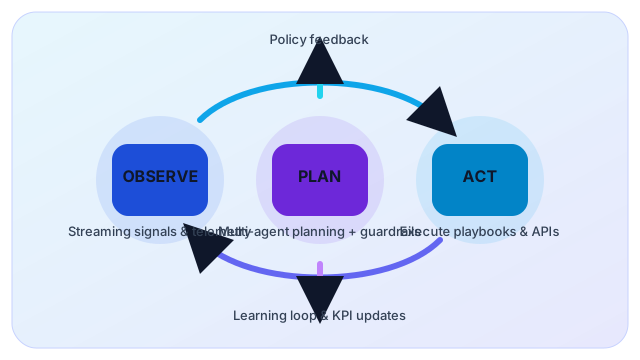
| Layer | What It Delivers | Typical KPIs | | --- | --- | --- | | Signal mesh | Streams KPIs, events, documents into vector/state stores | Event latency < 5s, 95% coverage of golden signals | | Planning fabric | Task decomposition, policy enforcement, handoff to functional agents | 60–80% reduction in manual triage, guardrail violation rate <1% | | Execution pods | Domain-specific agents (CI/CD, marketing ops, finance ops) triggering APIs and workflows | Cycle time reduction 35–50%, exception auto-resolution 40% | | Outcome intelligence | Continuous learning, KPI attribution, human-in-the-loop reviews | Story-to-spec accuracy 90%+, rollback incidents ↓ 60% |
Implementation Playbook
- Instrument: Land telemetry from the current workflow—tickets, metrics, customer signals—into a shared context store.
- Codify guardrails: Work with compliance and engineering leads to define policy prompts and risk thresholds before automating execution.
- Pilot a closed loop: Pick a bounded scenario (e.g., release readiness) and let agents propose, execute, and report on actions with human approval toggles.
- Scale through abstraction: Package successful loops as reusable capability pods (spec, QA, release, support) and expand to adjacent teams.
KPI Dashboard To Watch
- Story-to-AC acceptance: Percentage of user stories automatically converted into acceptance criteria that pass review.
- Exception recycle rate: How often an escalated incident comes back because the agentic fix missed context; target < 10%.
- Agent net impact: Calculated as (hours saved + risk avoided) − (escalations + overrides).
Case Snapshot: Global Insurer SDLC Copilot
- Problem: 21-day average release cycles with inconsistent spec quality.
- Solution: Agent network for story clarification, test planning, and release risk scoring with policy-guarded automation hooks.
- Impact: 47% faster release cadence, 0 critical severity regressions across three quarters, analyst hours repurposed to proactive testing.
Agentic AI will not replace teams; it arms them with continuously learning teammates that codify best practices, surface risks earlier, and execute faster than traditional automation. The enterprises building agent fabrics today are laying the foundations for self-healing, outcome-driven operations.